
How to Become a Floral Designer in Florida: A Step-by-Step Guide
Becoming a floral designer involves much more than learning how to make beautiful arrangements. Professional floristry combines artistic expression, botanical knowledge, technical skill, business awareness, and the ability to translate emotions into flowers.
Florida offers excellent opportunities for aspiring floral designers. Weddings, hospitality, luxury events, corporate celebrations, and an active year-round social calendar create demand for trained professionals. However, building a sustainable career requires a strong foundation and consistent hands-on practice.
This guide explains the essential steps to becoming a professional floral designer in Florida and how to choose the right educational path.

1. Understand What Professional Floral Designers Do
A floral designer selects, conditions, arranges, and presents flowers and botanical materials for occasions ranging from everyday celebrations to large-scale events.
Depending on their specialization, floral designers may create:
Wedding bouquets and ceremony installations
Sympathy and funeral designs
Corporate and hotel arrangements
Retail floral products
Event centerpieces and decorative installations
Artistic and competition designs
Seasonal displays and holiday décor
A designer must also understand construction techniques, flower care, visual composition, product costing, client communication, transportation, installation, and time management.
The profession offers several career paths. Graduates may work in a retail flower shop, wedding or event studio, hotel, wholesale business, or production company. Others become freelancers, open their own floral businesses, teach, or pursue advanced professional credentials.

2. Build a Strong Technical Foundation
Creativity is important, but professional results depend on technique.
Every aspiring floral designer should develop a working knowledge of the elements and principles of floral design, including:
Line, form, color, space, pattern, size, fragrance, and texture.
Balance, proportion, rhythm, contrast, dominance, harmony, and unity
Professional flower processing and conditioning
Secure construction and appropriate mechanics
Selection and care of flowers, foliage, and botanical materials
Color theory and effective color combinations
Design evaluation and visual problem-solving
These concepts help a designer understand not only how to create an arrangement, but why it works visually.
Flower care is especially important in Florida. Heat and humidity can affect hydration, longevity, transportation, and installation. Designers must learn proper sanitation, conditioning, temperature management, and handling procedures to protect their products and deliver dependable results.
3. Choose the Right Learning Path
Some floral designers begin by assisting in a flower shop or practicing independently. This can provide valuable exposure, but self-directed learning may leave gaps in mechanics, terminology, design principles, or business practices.
Structured education gives students an organized progression from foundational concepts to more advanced applications. It also provides something that online tutorials alone cannot fully replace: immediate feedback from an experienced instructor.
A strong floral design program should include:
Instructor demonstrations
Substantial hands-on practice
Individual critiques and corrections
Repetition of essential techniques
Exposure to different design styles
Professional terminology and standards
Finished work that can contribute to a portfolio
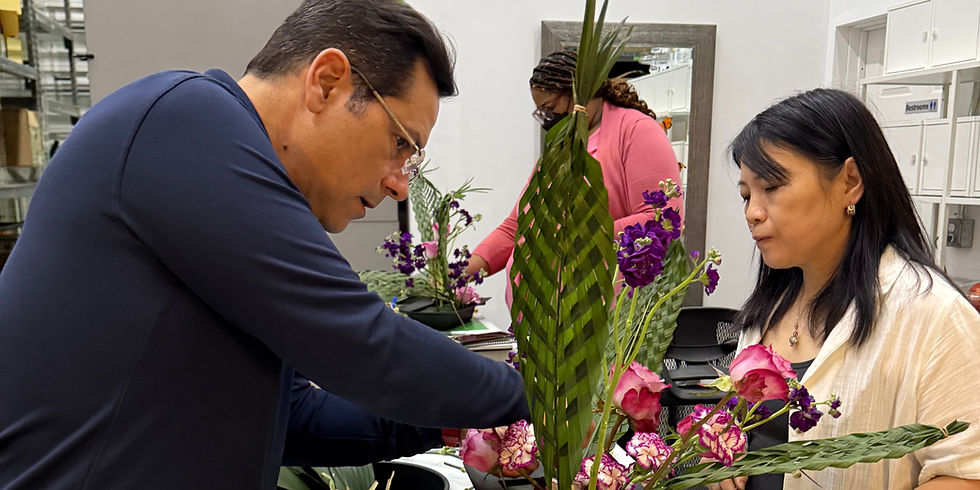
In-person floral design classes are particularly valuable because students can see construction methods closely, work with real materials, and receive guidance while the design is being created.
4. Develop Business and Customer-Service Skills
A successful floral career requires more than artistic ability. Designers must understand how their work creates value for a customer and how to price that work responsibly.
Important business skills include:
Calculating the cost of flowers, supplies, and mechanics
Accounting for labor, delivery, installation, and waste
Creating accurate proposals and design recipes
Conducting client consultations
Managing expectations and communicating professionally
Planning production schedules
Photographing and presenting finished work
Maintaining vendor and customer relationships
A beautiful arrangement that is incorrectly priced can cause a business to lose money. Professional education should help students see floral design as both a creative discipline and a commercial service.
5. Understand Certification and Professional Credentials
Florida does not require one universal license to work as a floral designer. Nevertheless, education and recognized credentials can strengthen professional credibility, improve technical knowledge, and demonstrate commitment to the industry.
It is important to understand that certification and accredited membership are not the same designation.
The American Institute of Floral Designers AIFD explains that candidates may pursue the Certified Floral Designer credential through approved educational pathways and additional AIFD requirements. Accredited Membership in AIFD is a separate professional distinction involving participation in the Professional Floral Design Evaluation.
An AIFD Education Partner can provide relevant education and preparation, but the final professional credential is awarded by AIFD after its requirements have been satisfied.

6. Practice Consistently and Create a Portfolio
Floral design is learned through repetition. Each completed arrangement develops greater control over proportion, mechanics, color, product selection, and finishing details.
As skills improve, students should begin creating a professional portfolio. A useful portfolio should demonstrate variety rather than showing multiple versions of the same design.
Consider including:
A hand-tied bouquet
A centerpiece
An arrangement featuring strong line movement
A sympathy design
A wearable floral accessory
A composition demonstrating color harmony
A larger event or installation piece
Work showing both traditional and contemporary styles
Photograph every design against a clean background with consistent lighting. Include close-up images when the mechanics or details are important. Quality matters more than quantity.
7. Choose a Floral Design School Carefully
Not every floral class provides the same depth of instruction. Before enrolling, review the program’s curriculum, instructor qualifications, class size, materials, schedule, and intended outcomes.
Ask the following questions:
How much of the program is hands-on?
Will I create my own designs or only watch demonstrations?
Does the curriculum teach design principles as well as techniques?
Will I receive individual feedback?
Are flowers and educational materials included?
What credentials and professional experience does the instructor have?
Does the course address flower care and business fundamentals?
Does the program help students prepare for professional certification pathways?
How many students are accepted in each class?
Small-group instruction can be especially beneficial because it allows the instructor to observe each student’s work, correct construction problems, and explain how to strengthen the final design.
8. Begin Building Your Floral Design Career
After completing foundational training, the next step is gaining practical experience.
New designers can begin by:
Assisting an established florist or event designer
Applying for a position in a retail flower shop
Participating in professional floral organizations
Attending workshops and industry programs
Practicing designs for a professional portfolio
Building relationships with photographers and event professionals
Offering a focused selection of services
Continuing their education in specialized areas
Avoid trying to offer every possible floral service immediately. It is often more effective to begin with a clear specialty, dependable standards, and a manageable product offering.
Professional growth takes time. Strong designers continue studying, experimenting, receiving critiques, and refining their technique throughout their careers.

Why Study Floral Design at Ornatus Floral Academy?
Ornatus Floral Academy provides professional, hands-on floral design education in Davie, South Florida. As an AIFD Education Partner, the academy welcomes beginners and experienced designers seeking structured training, certification preparation, and continued professional development.
Classes are taught in small groups, allowing students to receive personalized instruction and constructive feedback. Programs are available in English, Spanish, and Portuguese.
The academy’s 10-Day Intensive Floral Design Program combines approximately 60 academic hours of instruction with the creation of around 25 floral designs. Students study professional mechanics, flower care, design principles, color, composition, and a broad range of commercial floral applications.
Instruction is led by Alejandro Figueira Fernandes, AIFD, CFD, CEJ, PFCI an internationally recognized floral designer, educator, evaluator, and competitor.
Frequently Asked Questions
Do I need experience before enrolling in floral design classes?
Not necessarily. A well-structured foundational program should introduce beginners to the essential tools, mechanics, terminology, and design principles. Experienced designers may also benefit by correcting technical gaps and developing more consistent professional standards.
How long does it take to become a floral designer?
The initial foundation can be developed through an intensive program, but professional mastery requires continued practice. The timeline depends on the student’s goals, previous experience, practice schedule, and chosen specialization.
Is floral design certification required in Florida?
There is no single universal floral design license required to work in Florida. However, formal education and professional credentials can demonstrate knowledge, improve credibility, and support career advancement.
Can floral design become a full-time career?
Y
es. Floral designers work in retail stores, event companies, hotels, studios, wholesale businesses, education, and independent businesses. Success depends on technical quality, business management, customer service, and consistent professional development.
Are in-person classes better than online lessons?
Online education can be helpful for theory and continuing education. In-person instruction offers the additional benefit of working directly with flowers, observing professional mechanics, and receiving immediate correction from an instructor. Many students benefit from combining both formats.
Take the First Step
A professional floral design career begins with a solid foundation. The right education can help you transform creativity into controlled technique, professional confidence, and practical career opportunities.
Explore the hands-on floral design classes and certification preparation programs offered by Ornatus Floral Academy in Davie, South Florida.
Written by Alejandro Figueira Fernandes, AIFD, CFD, CEJ, PFCI
Internationally recognized floral designer, educator, and founder of Ornatus Floral Academy.

Comments